

How delayed decisions can cost FMCG sales.
Every unresolved signal leaves a decision pending.
The longer an issue remains open, the harder it can be to recover the lost selling opportunity.
Review exceptions, name an owner, set a response deadline, and confirm closure.
Visibility shows the problem. Ownership moves it toward resolution.
A useful review ends with a named owner, a next action and a time to check the result.
Use each review to turn field evidence into a clear action—and use the result to improve the next decision.
The 48-Hour Gap: How Delayed Decisions Can Cost FMCG Sales
In FMCG, a problem can become visible long before anyone acts on it.
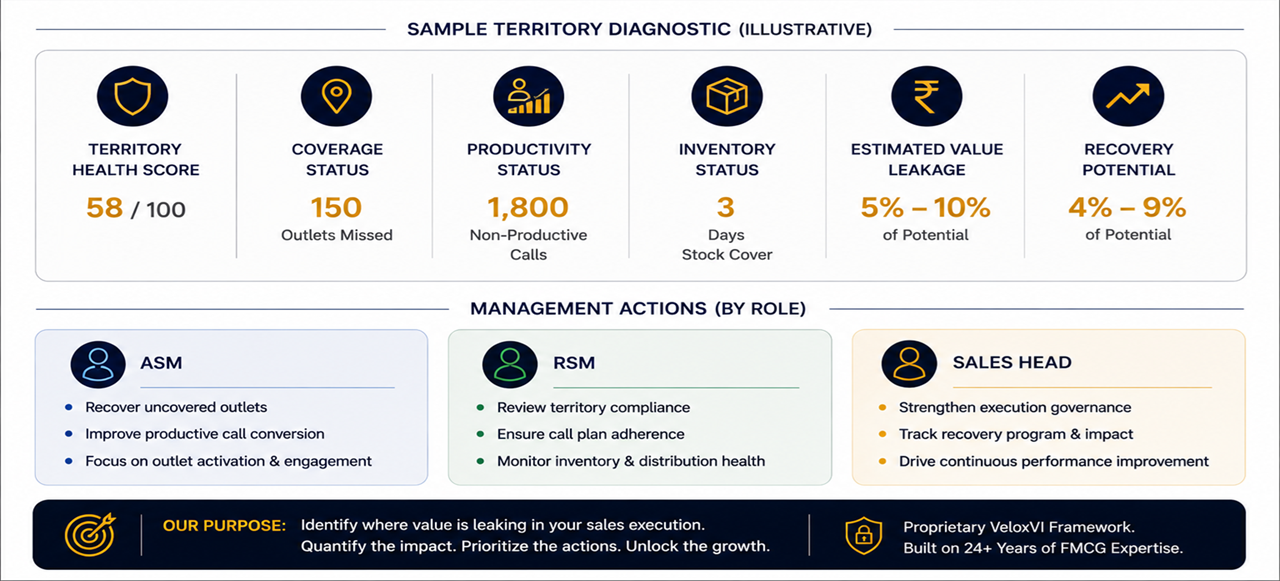
A priority SKU is unavailable at a productive outlet. A distributor’s fill rate starts declining. A territory misses its productivity target. The information may already exist in an SFA report, a DMS transaction or a sales dashboard.
But when does someone recognise the signal? When is the cause investigated? And how quickly does corrective action reach the market?
The time between detection and action is an important, often overlooked part of commercial execution. A stock-out identified today but addressed several days later is not the same business problem as one corrected during the next market visit.
Can your organisation respond while the opportunity to recover value still exists?
Where does the delay occur?
How long before the signal is noticed and treated as an exception?
Can the team distinguish a data symptom from the underlying cause?
Is an action owner clear, with an escalation path and deadline?
Does management confirm that the corrective action changed the outcome?
What FMCG leaders can measure
- Time from first signal to detection.
- Time from detection to diagnosis and action assignment.
- Time from action assignment to resolution.
- Repeat exceptions and whether corrective actions prevent recurrence.
Where AI can help
AI can help surface unusual patterns, rank exceptions by urgency and suggest next steps. Reliable action still depends on data quality, business context, clear ownership and appropriate human oversight.
Note: “48 hours” is an illustrative discussion framework, not an industry benchmark. Appropriate response times depend on the issue, product, market and operating model.
Have a similar execution challenge?
Discuss Your Business Question